
A field guide to how software architecture patterns evolved — and why, in 2026, the debate has shifted from “which pattern wins” to “which pattern fits.”
By Arijit Ghosh · Engineering Practices · July 2026
For two decades, software architecture discourse has been framed as a series of contests: monoliths versus microservices, synchronous versus event-driven, servers versus serverless. Each new pattern arrived with enough hype to make the previous one look obsolete. In practice, none of them replaced the last one outright — each solved a specific problem, introduced a new cost, and left room for the next correction. Understanding that cycle is more useful than picking a side in it.
Key takeaways
- Every architecture era solved a real bottleneck and introduced a new one — none of them is “wrong,” each is contextual.
- By 2026, hybrid, fit-for-purpose systems dominate: start as a modular monolith, then extract microservices, event-driven, or serverless components only where a concrete need justifies the operational cost.
- Four forces recur in every real decision: performance under load, operational complexity, cost as the system grows, and portability.
- AI-native and agentic architecture is forming as a genuinely new layer — and most production agent failures are architectural (missing planning, reflection, or state), not model-quality problems.
This article walks through six architectural eras, what each one actually solved, where it broke down, and where the field has landed today.
1. Monolithic architecture: the foundation of early software systems
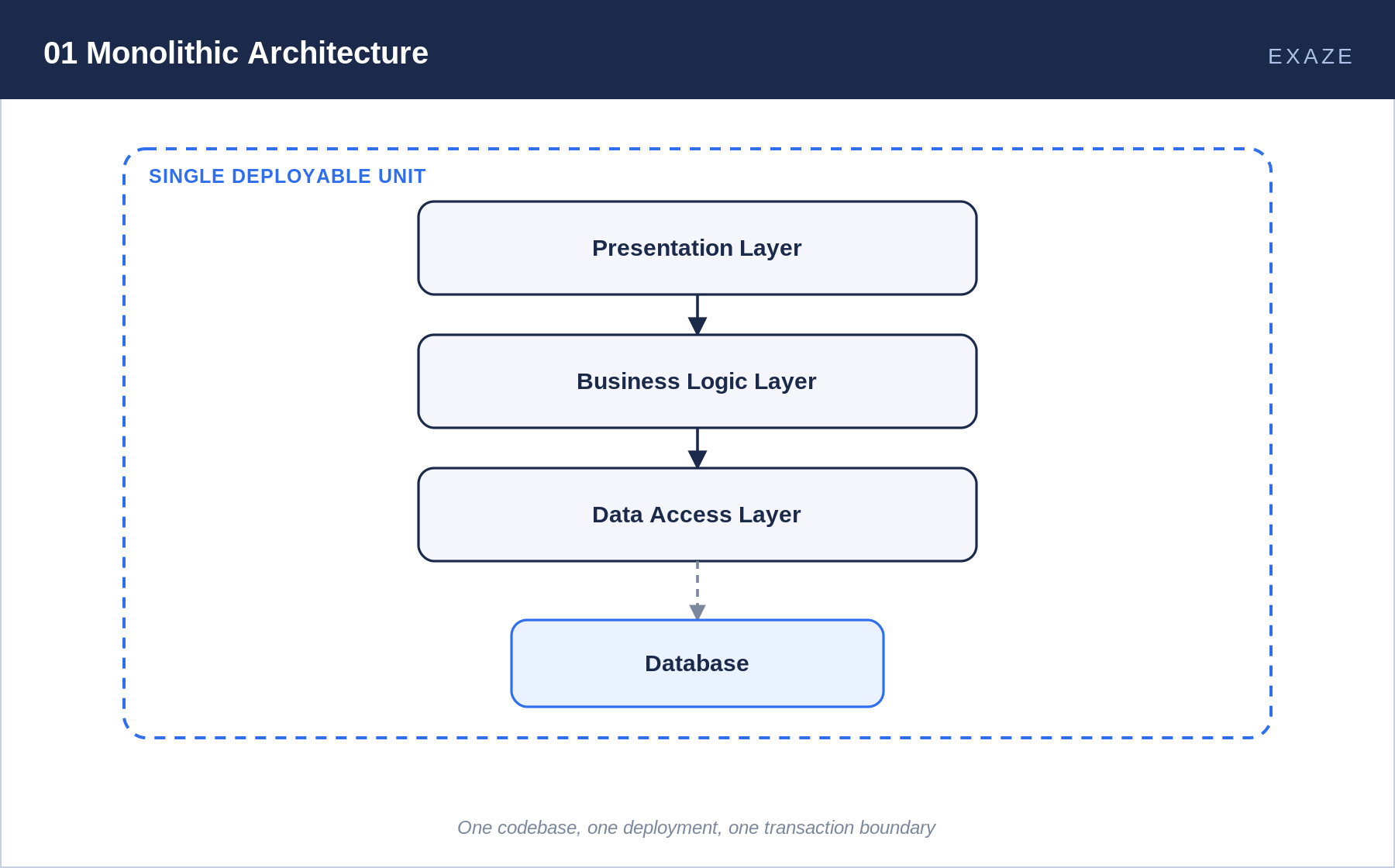
Monolithic architecture builds an entire application as a single, unified unit with tightly coupled layers — typically presentation, business logic, and data access — all deployed and scaled together.
Monoliths are easy to debug, since one stack trace covers the whole request. In-process calls are fast, with no network hop between components, and because everything runs inside one transaction boundary, monoliths offer strong transactional consistency with no distributed-transaction coordination required.
The trade-off shows up as the application grows: scaling a monolith means replicating the entire system, even if only one component is under load, and every deployment ships the whole codebase at once — which slows release velocity as the team grows.
The monolith didn’t disappear — it got disciplined. A well-structured modular monolith enforces clear internal boundaries between modules while still deploying as a single unit, preserving simplicity while avoiding the “big ball of mud.” Shopify’s large-scale Rails codebase remains the most commonly cited proof that this scales in production.
2. Service-Oriented Architecture (SOA): the first step toward distribution
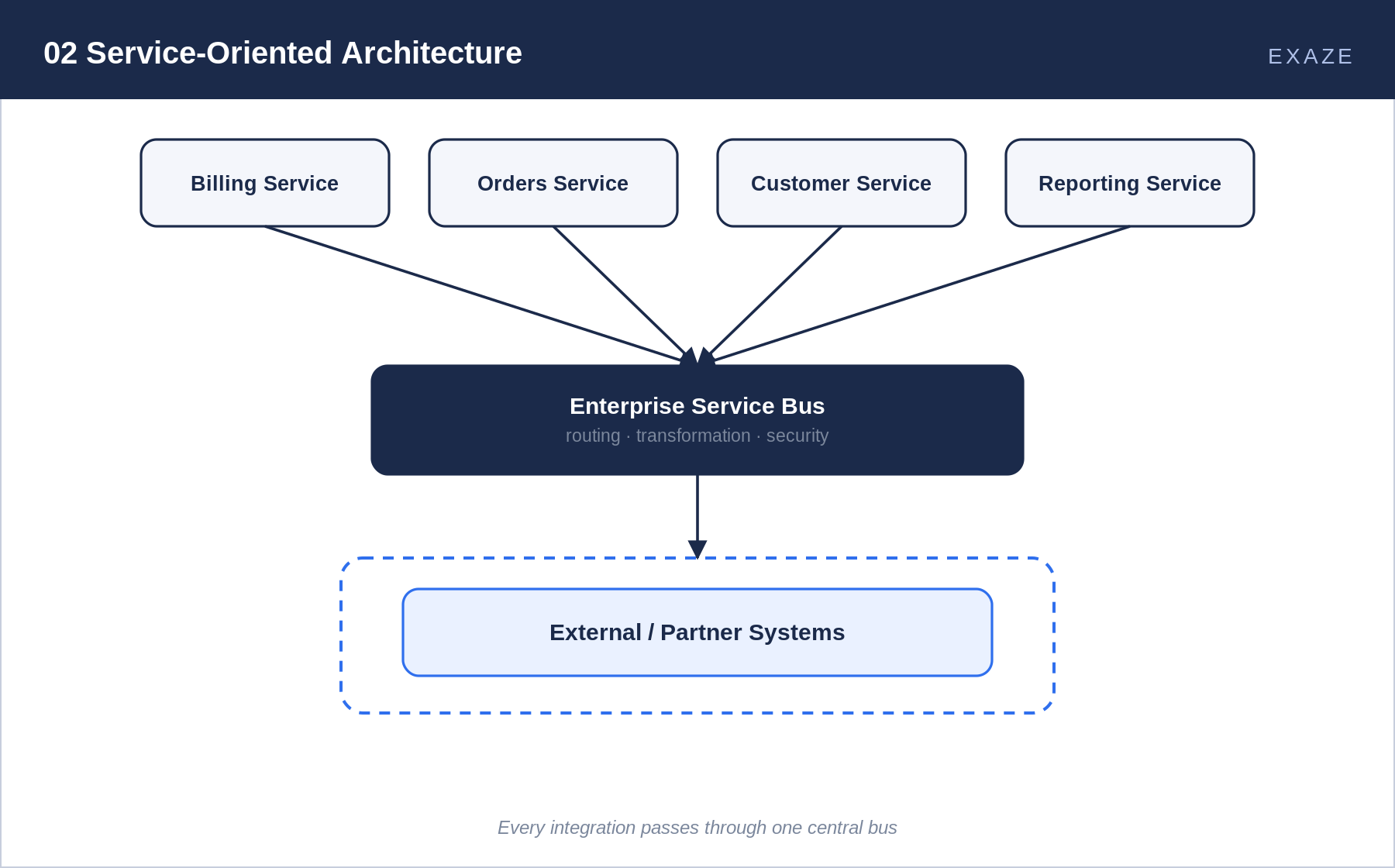
SOA was the first serious attempt to break a monolith apart, decomposing a system into reusable services that communicate over standardised interfaces — historically SOAP and XML — so services built by different teams or tech stacks could interoperate.
Its architectural centrepiece, the Enterprise Service Bus (ESB), centralised message routing, data transformation, security, and orchestration — making integration and governance possible at enterprise scale. But the ESB itself became a bottleneck: a central point of complexity and tight coupling, where changes to one service often required coordinating bus configuration, undercutting the independence SOA promised.
SOA’s core ideas — loose coupling, service contracts, standardised interfaces — didn’t go away. They’re the conceptual bridge between monoliths and microservices, and most of today’s API design best practice traces back to SOA-era thinking.
3. Microservices architecture: independent services at scale
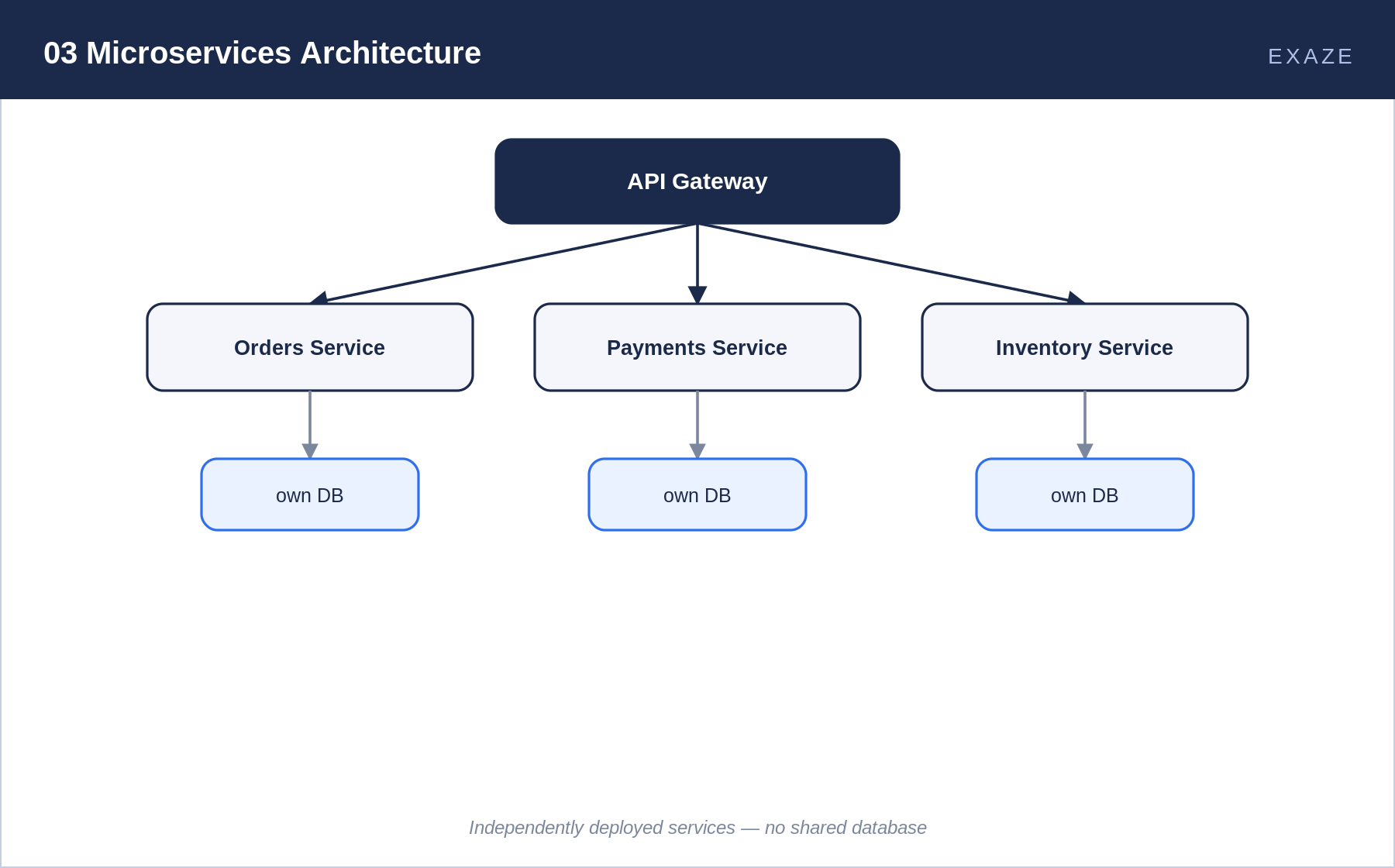
Microservices took SOA’s decomposition instinct further, without the centralised bus. Each service is small, autonomous, and focused on one business capability, with its own data ownership — no shared database between services.
Services typically communicate via REST, gRPC, or async messaging. Because each is independently deployable, microservices pair naturally with CI/CD and enable much faster release cycles than a monolith allows — but that independence has a cost. Microservices introduce service discovery, distributed tracing, cross-service data-consistency problems, and the need for explicit resilience patterns (circuit breakers, retries, bulkheads). Debugging a request that fans out across six services is materially harder than debugging a single stack trace, even with excellent observability tooling.
Microservices fit best on mature teams operating on a strong platform — established CI/CD, observability, and service-mesh infrastructure already in place. Premature adoption, especially by small teams, tends to produce complexity overload without the organisational scale to justify it.
4. Event-driven architecture: designing for asynchronous systems
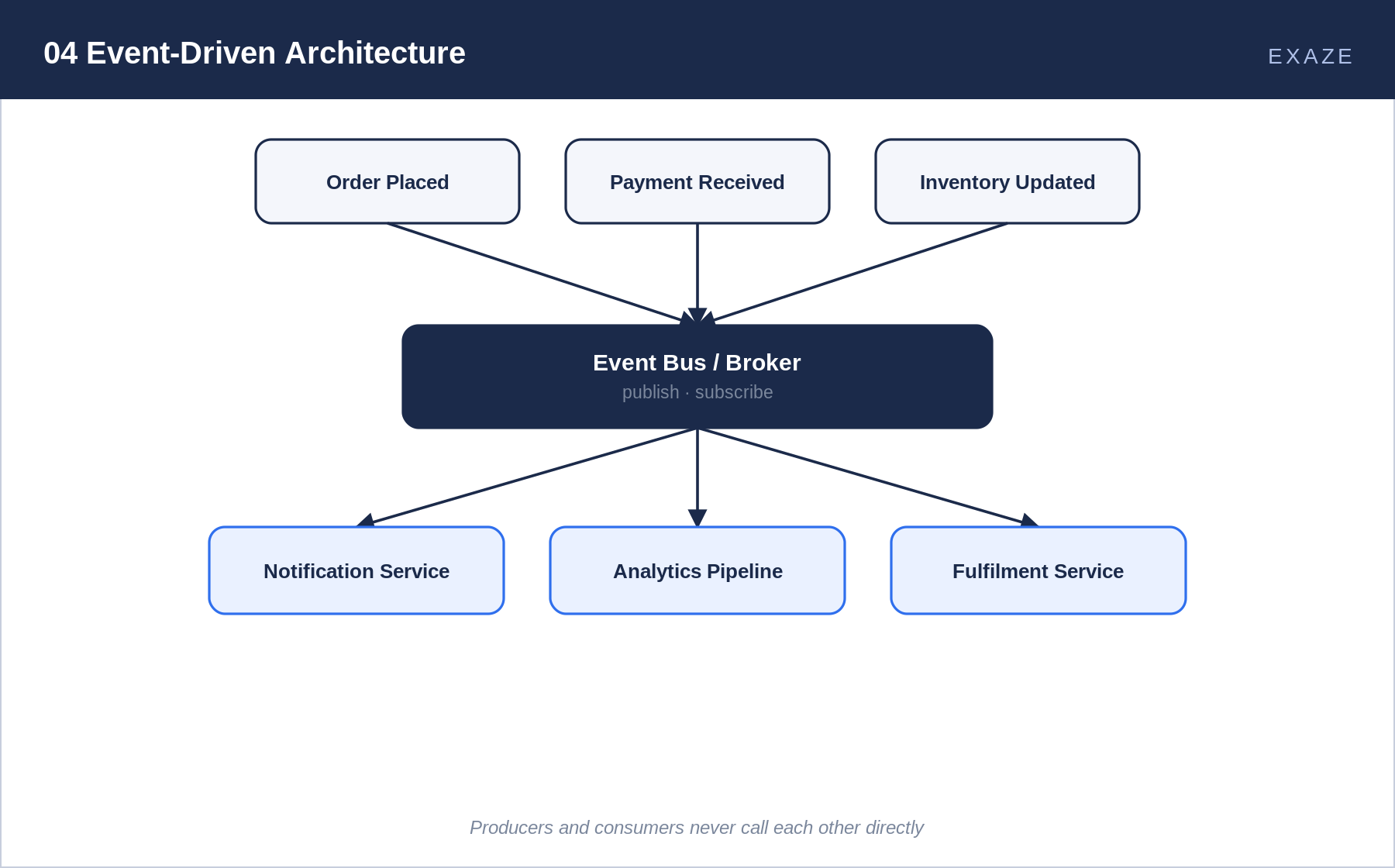
Event-driven architecture (EDA) shifts communication away from direct request/response calls toward asynchronous, event-based workflows. Services publish events when something happens and react independently, decoupling producers from consumers entirely.
Because components aren’t directly coupled to each other’s availability, event-driven systems handle real-time load and partial failures more gracefully — a downstream consumer being temporarily unavailable doesn’t block the producer. That makes EDA a natural fit for e-commerce order pipelines, IoT telemetry, financial transaction processing, and real-time analytics.
The flexibility comes with a governance problem: effective EDA requires deliberate design around consistency guarantees, cross-chain observability, and schema/contract governance. Without it, systems drift into “event sprawl,” where nobody has a clear picture of who produces or consumes what.
5. Serverless architecture: abstracting infrastructure complexity
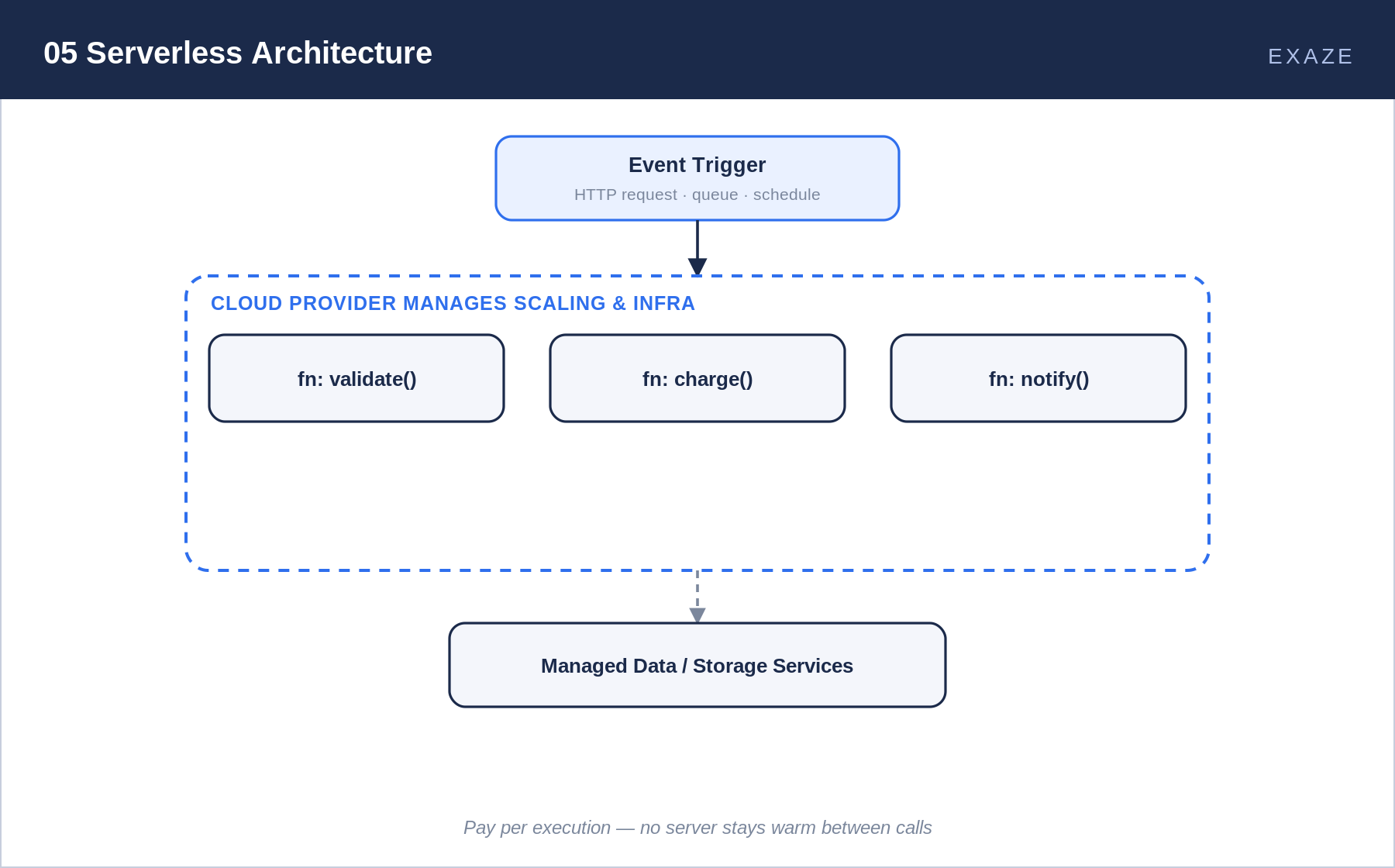
Serverless lets developers write business logic while the cloud provider handles provisioning, scaling, and patching entirely. Function-as-a-Service (FaaS) platforms execute code in response to events or HTTP requests without a long-running process staying warm.
The upside is automatic scaling and cost efficiency for bursty or unpredictable workloads — you pay for execution, not idle capacity. The downside is cold-start latency and vendor lock-in, since serverless offerings are often tightly coupled to a specific provider’s runtime and event model. In practice, serverless rarely stands alone: it complements microservices and event-driven systems, handling the bursty, event-triggered edges of a system rather than replacing always-on architecture wholesale.
6. Hybrid architecture: fit-for-purpose systems in 2026
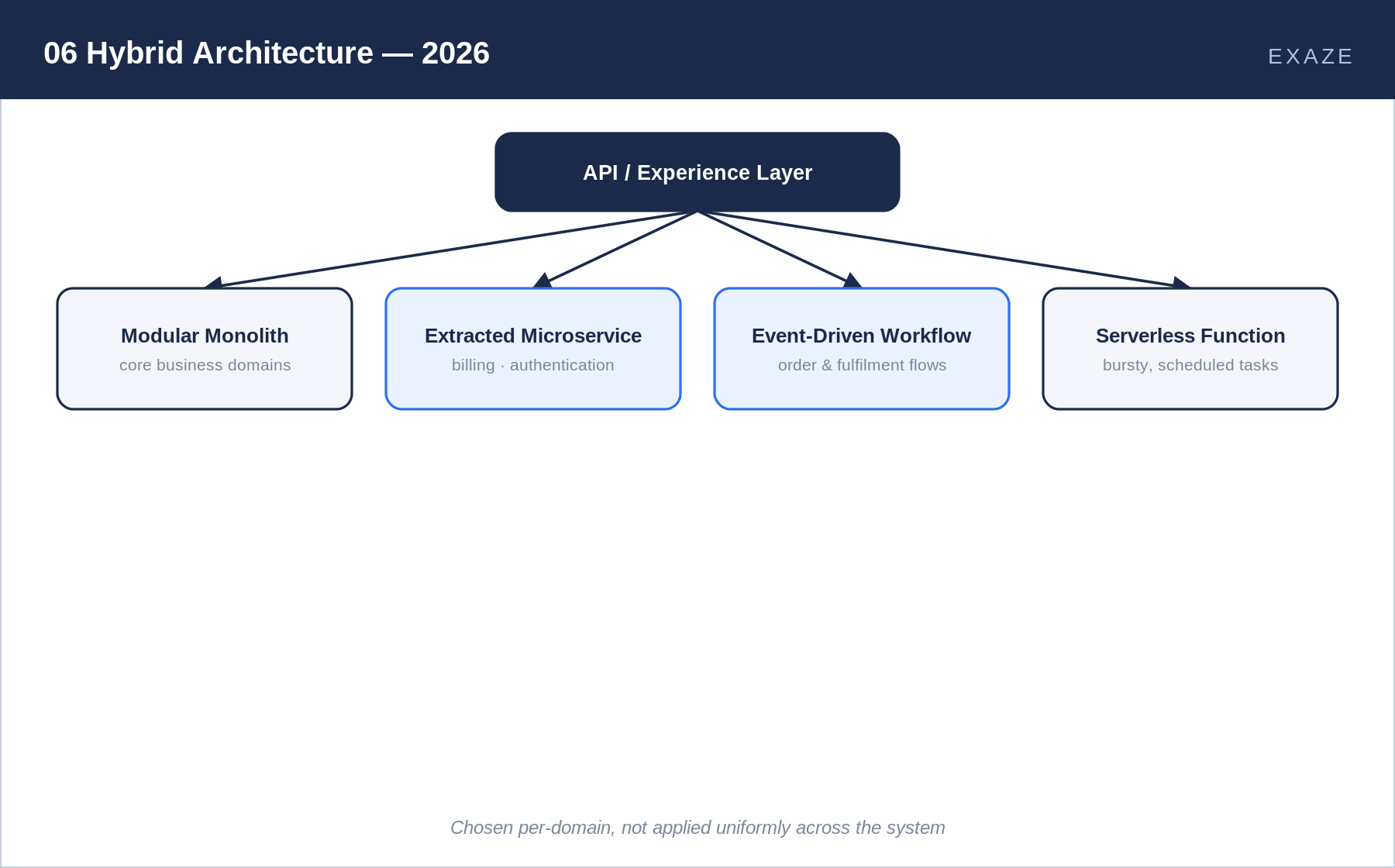
By 2026, the dominant pattern isn’t a pattern at all — it’s a deliberate blend. Modern systems intentionally combine modular monoliths, microservices, event-driven workflows, and serverless components, chosen per-domain rather than applied uniformly.
The architecture decision now explicitly accounts for domain volatility, team structure, and operational maturity — a billing system and a reporting dashboard in the same company may reasonably use entirely different patterns, because they carry different volatility, ownership, and scaling profiles.
The common trajectory has reversed from a decade ago. Instead of starting distributed “for scale,” most systems now start simple — as a modular monolith — and evolve by extracting specific microservices or event-driven components only where a concrete need justifies the added operational cost. Billing, authentication, and reporting tend to be the first candidates extracted, since they have clear boundaries and independent scaling needs. Architecture in 2026 is also treated as inseparable from team topology: stream-aligned teams, platform engineering, and observability investment are architectural concerns in their own right, not just downstream implementation details.
Six eras, side by side
| Era | Core idea | Primary win | Primary cost | Best fit today |
| Monolithic | Single deployable unit | Simplicity, fast debugging, transactional consistency | Scales as one block; slower release velocity | Modular monolith for small/mid teams, clear-boundary domains |
| SOA | Standardised contracts via an ESB | Enterprise-scale integration & governance | Central bus becomes a bottleneck | Legacy integration; conceptual root of modern API design |
| Microservices | Independent, autonomous services | Independent deployability, faster releases | Distributed complexity, harder debugging | Mature teams with strong CI/CD & observability |
| Event-Driven | Async, decoupled producers/consumers | Resilience, real-time scale | Schema governance, “event sprawl” risk | High-volume, low-latency domains (commerce, IoT, fintech) |
| Serverless | FaaS abstracts infrastructure | Auto-scaling, pay-per-execution | Cold starts, vendor lock-in | Bursty, event-triggered workloads alongside other patterns |
| Hybrid | Fit-for-purpose blend per domain | Right-sized complexity | Needs strong architectural judgment | Most production systems in 2026 |
The pattern underneath the patterns
Look at the six eras together and a shape emerges: consolidation, followed by distribution to solve a real bottleneck, followed by a correction once the operational cost of that distribution became clear. Monolith → SOA solved integration at the cost of a centralised bottleneck. SOA → microservices solved that bottleneck at the cost of distributed-systems complexity. Microservices → modular monolith/hybrid solved that complexity by right-sizing decomposition to only where it’s actually needed.
None of these patterns is “correct” in the abstract. Each involves a trade-off between four forces that recur in every real decision: performance under load, operational complexity, cost as the system grows, and portability. A pattern that’s the obvious right choice for a 200-engineer fintech company processing millions of transactions a day may be pure overhead for a five-person startup validating a product.
There’s also a genuinely new layer forming alongside these six, rather than replacing any of them: AI-native and agentic architecture. Production AI agent systems in 2026 are treated as full architectures in their own right — with distinct layers for reasoning, tool use, memory, and orchestration — using emerging patterns like ReAct loops, orchestrator-worker decomposition, and plan-and-execute with re-planning. The recurring lesson from teams running these in production is that agent failures are usually architectural, not model-quality problems: missing planning, missing reflection, or no explicit state object for long-running tasks. It’s early, but it’s shaping up to be the next entry in this same cycle — distribution first, discipline second.
The real question was never which pattern wins. It’s matching the pattern to your team, your domain, and your stage — and being willing to revisit that match as all three change.
Exaze works with engineering leaders across banking, retail, healthcare, and travel to make exactly these fit-for-purpose calls — from modular-monolith foundations, through targeted microservice and event-driven extraction, to production-grade agentic systems. Talk to our engineering team about your next architecture decision.